
Reviewed · ARASHIYAMA & BAMBOO GROVE TOURS
Kyoto Arashiyama Rickshaw Tour with Bamboo Forest
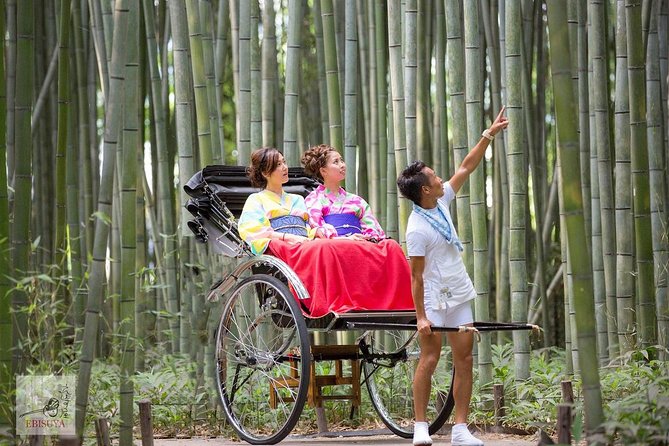
Kyoto’s bamboo forest looks best when you time it right. This rickshaw tour gets you into the green rush of Arashiyama early, with a mix of pulled riding and short walks. Expect bamboo paths, shrine scenery, and guides who talk and photograph while you enjoy the ride.
Two things I like a lot: the combo of rickshaw and on-foot viewing. You get access to parts the rickshaw can handle, then you step out for the most iconic stretch. Second, the human factor, guides like Ocean, Kei, Shota, Utay, Yoppi, and Hikaru show up again and again in praise, especially for clear English and photo help.
One drawback to plan for: you are not fully seated for the whole thing. There’s walking time, including a steep slope, and if it’s crowded or hot, it can feel like a lot. Also, this is rain or shine, so go with layers.
Key things to know before you go
- Early start helps: you’ll aim for quieter bamboo-forest moments by going in the morning.
- A short walk for the famous section: you’ll get off for up and down slope views the rickshaw can’t reach.
- Photo-focused stops: there are designated bamboo and scenic-photo breaks, with guides praised for picture skills.
- Shrine and cultural stops: you pass Nonomiya Shrine and visit a Shinto shrine and a traditional haiku poet cottage.
- Private group setup: only your group participates, with a rickshaw sized for up to two adults side by side.
Entering Arashiyama bamboo with a rickshaw mindset
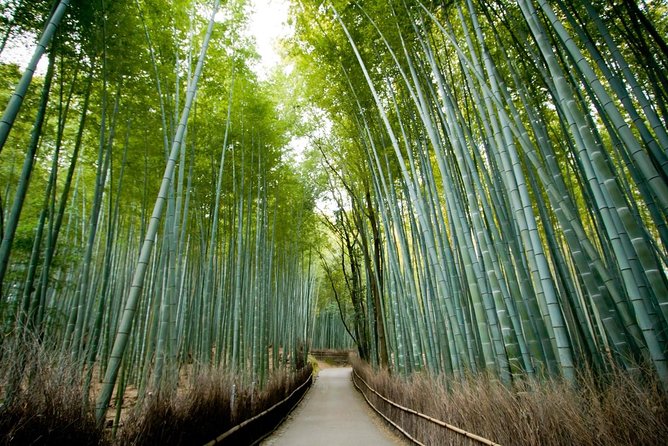
The Arashiyama bamboo forest is one of those places that can either feel magical or like a human traffic jam. A rickshaw changes your experience fast, because you’re not fighting foot traffic at every bend.
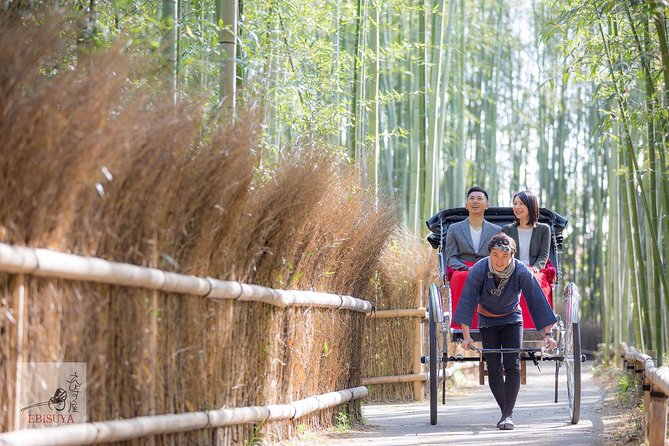
I like that this tour is built around a realistic rhythm. You get pulled through parts of bamboo on paths reserved for rickshaws, then you shift modes when it makes sense. That mix is the sweet spot in Arashiyama, because the bamboo is dense and sightlines can be tricky. From the first ride segment, you’re close enough to feel the scale, but you’re still moving.
You also get a guide who acts like a local translator for what you’re seeing. People often imagine bamboo is just bamboo. Here, you’ll also connect it to shrines and literature, including a cottage tied to a famous haiku poet with a straw-thatched roof.
You can also read our reviews of more tours and experiences in Kyoto.
Meeting point and timing: how 1 to 2 hours plays out
The tour starts at 1-1 Sagatenryūji Susukinobabachō, Ukyo Ward, Kyoto (near public transportation). You finish back at the rickshaw stand by default, but your finishing location can be customized with the operator. If the drop-off isn’t the standard one, there may be an additional fee paid on the day.
Plan for about 1 to 2 hours total, and remember the tour runs rain or shine. The timing matters because the bamboo forest crowds are not subtle. The tour itself strongly favors an early morning start to avoid peak congestion, so if your Kyoto schedule is flexible, give this one the best time slot you have.
One more timing detail that affects your comfort: if you’re late, the time you arrive late is deducted from your tour duration. If you’re more than 10 minutes late, it can lead to cancellation. That means you should build buffer time on the day, especially if you’re coming from another neighborhood.
Riding through the bamboo: the shaded, guided bamboo-forest street segment
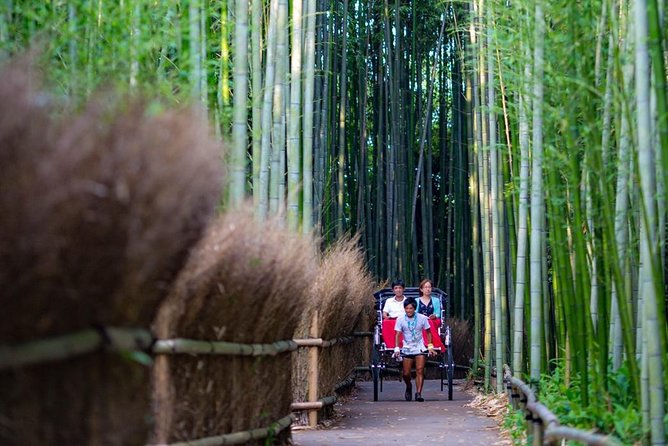
This part feels like “slow travel” with steering wheels. Your guide pulls you through the greenery on the bamboo paths that rickshaws can access. You’ll see bamboo from the inside, not just from the edge, and you’ll get a guide who can point out what to watch for.
In the early ride phase, you’ll also pass key landmarks. One big one is Nonomiya Shrine, plus there’s a photo stop at a small park along the way. That matters because in Arashiyama, the best shots often need positioning, not just a phone pointed at bamboo. Guides who are good at the job help you get angles without you stepping into the flow of other groups.
A practical perk: being pulled by rickshaw gives you shade and less walking fatigue. On hot days, people note that cold towels are provided, which is exactly the kind of small comfort that makes bamboo more enjoyable rather than exhausting.
Quick reality check about expectations
Some people come in thinking the rickshaw will carry them through every bamboo turn for the whole time. This tour includes a very clear “you get out and walk” section. So if your main goal is photos with minimal crowd contact, you’ll want to be ready to move your feet for the best access areas.
Stop 1: stepping out for the steep-slope walk to the famous bamboo stretch
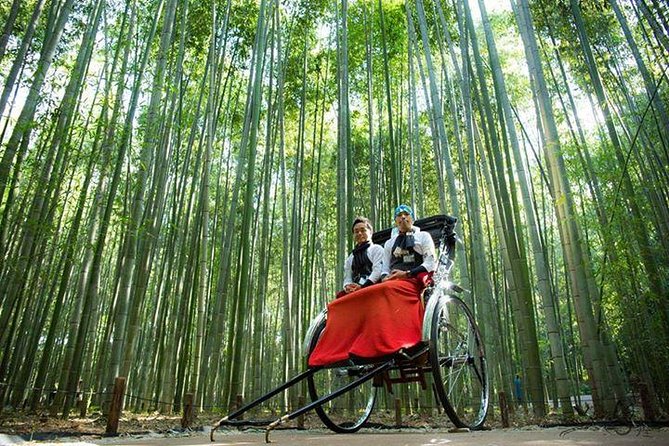
Here’s where the tour becomes more than a ride. At Bamboo Forest Street, you’ll disembark to walk to the most famous part of the bamboo forest that can’t be accessed by rickshaw.
This walk includes going up and down a steep slope. The time block is about 30 minutes. That’s enough time to see the big iconic views and take pictures, but not so long that you’ll feel like you did a full hike. Still, bring shoes you trust on uneven ground.
Why this stop is worth it: bamboo crowds tend to bunch up at the most obvious photo angles. Walking here briefly gives you a better shot at reaching the area on foot without you spending your whole morning weaving through people. Also, because you’re not stuck in a long line of tourists walking with no guidance, you tend to feel more oriented.
If you’re traveling with someone who struggles with stairs or steep grades, this is the part to think about first. The tour is marked as not recommended for pregnant travelers in the first 16 weeks, and the steep-slope segment is one reason.
Bamboo photo time: the grove segment and quick scenic breaks
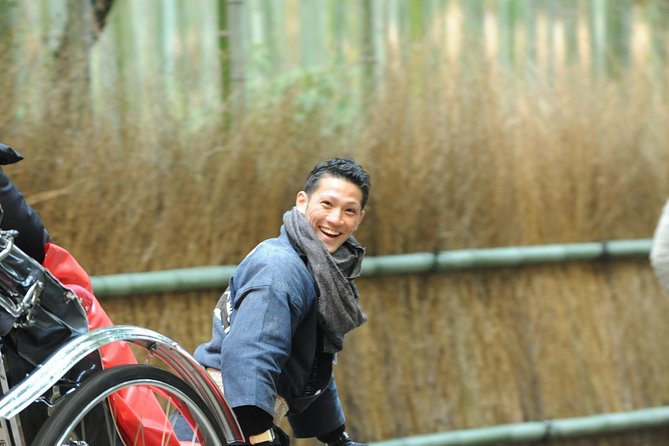
After the first on-foot stretch, the tour keeps moving through the bamboo for more views and photos. There’s also a short grove pass designed for pictures, with a time block of about 10 minutes and no extra admission stated for that segment.
In practice, this is where you’ll re-focus your camera skills. Bamboo can create tricky lighting, especially in morning hours when sun hits the stalks at odd angles. A good guide helps you time shots when the lines of people thin out or when there’s less backlighting.
This is also where you’ll notice how guide styles differ. Some guides in the provided feedback were praised for iPhone photo skills and even panorama-style picture coaching. You do not need to be a serious photographer to benefit. Even simple direction like where to stand and when to rotate your framing can turn a bland bamboo photo into a memorable one.
Shrines and haiku culture: Nonomiya, a Shinto shrine in bamboo, and a thatched cottage
Arashiyama bamboo is not just scenery, it’s a cultural setting. This tour weaves in spiritual and literary stops so the bamboo isn’t floating in a vacuum.
You pass Nonomiya Shrine early in the experience, and there’s also a Shinto shrine tucked into the bamboo forest. These stops matter because they explain why bamboo got protected and cultivated around religious spaces, not just turned into a selfie spot.
Then there’s the traditional haiku poet cottage, built in a pastoral style with a straw-thatched roof. It’s the kind of detail that makes bamboo feel anchored in Japan’s everyday cultural memory, not just as a trendy background.
One useful note: temple and shrine admission fees are not included. The good news is that many quick viewing stops can still fit a tight schedule, but you should expect that you might pay something depending on what the route includes at the time you go.
Guides who do more than drive: Ocean, Kei, Shota, and others
This kind of tour lives or dies by the guide, and the feedback you were given backs that up. You’ll likely get an operator who takes pride in the work, talks through what you’re seeing, and actively helps with photos.
Guides named in the feedback include Ocean, Kei, Shota, Utay, Yoppi, Kazuma, and Hikaru. People repeatedly praise things like friendly English, strong knowledge of the area, and photo help. Some guides also focus on making sure you feel relaxed, including managing pace so you’re not sprinting between photo points.
Here’s the practical part for you: if you care about photos, tell your guide what you want at the start. If you want group shots, say so. If you want fewer people in the background, ask where to stand and when to take photos. A good guide can adjust on the fly, especially during the morning window when timing can matter.
Price and value: what $86.88 really covers
At $86.88 per person, this is not the cheapest way to see bamboo. But it’s also not just a “seating tax” for being lazy. You’re paying for a few specific things that add up quickly:
- Rickshaw use (a real vehicle pulled by a working operator)
- All fees and taxes
- Gratuities included
The big value play is that you’re compressing effort. You get guided movement through the grove and the key on-foot viewing stretch, without needing to figure out the route yourself in the most chaotic part of Kyoto.
What is not included: transportation to and from the meeting place, plus any temple or shrine admission fees. If you’re planning to combine this with other Arashiyama stops, you’ll want to factor in transit time so you don’t stress about delays. And if you have to pay additional entrance fees at specific sites, that will slightly change your all-in cost.
Also, the tour can be customized based on the duration option you choose, including choice of attractions depending on your selected time. A longer option can be more cost-efficient if you’re the type who likes to pack in shrines and temple time without paying for a separate guide later.
Comfort and practical notes that can save your trip
This tour is designed for most people, but a few details can make or break the experience for your body.
- Seats and fit: the rickshaw seat measures 74 cm wide, so space can feel tight for some body types. It can accommodate up to two adults side by side.
- Kids: children 6 and older need a seat and pay the same price as adults. Kids 5 and under can ride for free if they sit on an adult’s lap. If a child 5 uses a seat, that child needs an adult booking.
- Weather: rain or shine. Bring a small umbrella or light rain layer, if you can.
- Pace: you will do some walking, including steep parts. If you’re managing mobility issues, consider whether that slope is realistic for your group.
And a small ethical and comfort point, based on the way this activity is experienced on hot days. Watching someone pull a rickshaw is impressive and also a reminder this is physical work. If you’re sensitive to that, you may still enjoy the tour, but it helps to choose a cooler morning, pace yourself, and stay considerate with the space around you.
Who this tour is best for
This rickshaw + bamboo forest plan fits best if you want a mix of iconic views and light guidance.
You’ll love it if:
- You want bamboo without doing a full-on walking scramble in crowds
- You like having a guide who can point out what matters and help with photo angles
- You want a cultural thread with shrines and haiku literary context
- You’re traveling as a small private group and want your own pace
You might reconsider if:
- You have mobility limits or you know the steep slope will be a problem
- You’re traveling with someone who needs lots of stroller accessibility
- You are pregnant in the first 16 weeks (not recommended)
- You’re the type who hates any walking at all during sightseeing
If you just want a quick photo run and you’re confident navigating Arashiyama on foot, you can do bamboo independently. But if you want an easier morning rhythm with less stress and more “where do I stand” help, this format is strong.
Should you book the Arashiyama bamboo rickshaw tour?
Book it if you want the classic bamboo forest experience with fewer headaches: early timing, a guided route, and the short on-foot segment that takes you to the area that really matters. For many people, it’s a Kyoto highlight because it combines views with storytelling and active photo help.
I’d skip it or pick a shorter, more tailored approach if steep walking is a concern or if you strongly prefer staying on the rickshaw the whole time. You cannot avoid the walking segment, and it includes a slope.
If your schedule allows an early morning start, and you’re ready for a bit of walking for the best bamboo access, this tour looks like a smart value. At $86.88 with rickshaw use and fees covered, you’re paying for convenience and guidance in the one place in Kyoto where convenience actually counts.
FAQ
How long is the Kyoto Arashiyama rickshaw tour with bamboo forest?
It runs about 1 to 2 hours total.
What does the tour include in the price?
The price includes rickshaw use, all fees and taxes, and gratuities. Temple and shrine admission fees are not included.
Do I need to pay extra for shrines and temples?
Admission fees for temples and shrines are not included, so you may need to pay depending on what stops are included during your route.
Where does the tour start and end?
It starts at 1-1 Sagatenryūji Susukinobabachō, Ukyo Ward, Kyoto, and by default it ends at the same rickshaw stand. Your finishing location can be customized, and a drop-off fee may apply for non-standard locations.
Is the tour private?
Yes. It’s a private tour, and only your group participates.
Can I choose attractions or customize the route?
Yes. The tour can be customized, and the choice of attractions depends on the duration option you select.
What should I know about late arrival?
If you’re late, the time you are late will be deducted from your tour duration. A delay of 10 minutes or more can result in automatic cancellation.
Can I cancel and get a refund?
Yes, free cancellation is available up to 24 hours in advance for a full refund. If you cancel less than 24 hours before the start time, you do not get a refund.
More Tours in Kyoto
More Tour Reviews in Kyoto
Not for you? Here's more nearby things to do in Kyoto we have reviewed


Arashiyama & Bamboo Grove Tours, compared.
 ★ 4.8Fushimi Inari, Kinkakuji, Bamboo Grove 1 Day Bus TourFrom $1224,316 reviews
 ★ 4.1Osaka/Kyoto:Kinkakuji,Arashiyama,FushimiInariShrine,NaraParkFrom $661,596 reviews
 ★ 4.7Kyoto/Osaka: Nara, Fushimi Inari Taisha, Arashiyama Bus TourFrom $521,275 reviews
 ★ 5.0Kyoto Arashiyama Walking Tour: Bamboo, Monkeys, Gardens & SecretsFrom $651,216 reviews
 ★ 4.8Arashiyama Bamboo, Temple, Monkeys, or Secret Sake BreweryFrom $87886 reviews
 ★ 5.0Arashiyama Bamboo Forest, Monkeys, Matcha & Temple TourFrom $53759 reviews
 ★ 4.4Osaka/Kyoto: Arashiyama, Nara & Fushimi Inari Shrine w/LunchFrom $61754 reviews
 ★ 5.0Nijo, Kinkaku-ji, Arashiyama, Kiyomizu & Fushimi InariFrom $51699 reviews
Browse the lists this tour appears in