
Reviewed · FUSHIMI INARI SHRINE TOURS
Kyoto Magical Night English Tour: Gion & Fushimi Inari Shrine
Fushimi Inari at night feels like a movie set. This Kyoto magical evening tour pairs Fushimi Inari with the quiet edges of Gion, so you see the famous stuff without feeling swallowed by daytime crowds. Two things I really like: you get guided context for Shinto shrines and the Gion geisha-era vibe, and you also get help with photos as you walk.
One possible drawback to plan for: this is a walking tour. It’s built for people with moderate stamina, and the pace can feel brisk if you’re not used to steady evening steps.
Key Highlights You’ll Feel on This Kyoto Night Walk
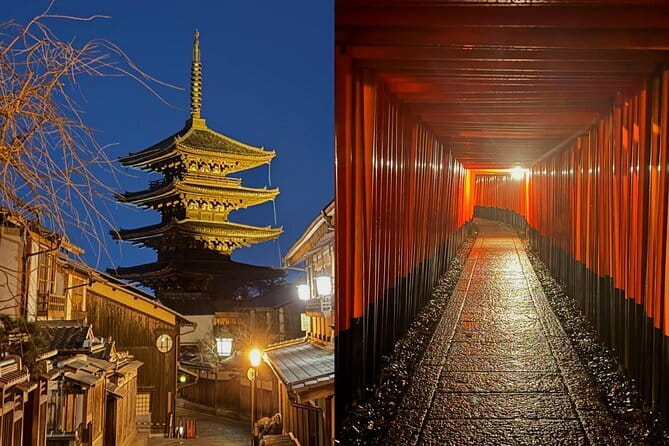
- Fushimi Inari after dark, when the torii tunnel looks softer and more magical
- Gion and Hanamikoji Street with a chance to spot traditional scenes while learning what you’re seeing
- Yasaka and Hokanji sights in the same route, including the big visual impact of Yasaka Pagoda
- Shrine-prayer guidance, including what to do when you reach the key moments
- Professional photo help, with many guests receiving photos fast after the tour
- Private tour by default, so your group size stays tight when bookings are low
A 2.5-Hour Kyoto Night Plan That Actually Makes Sense
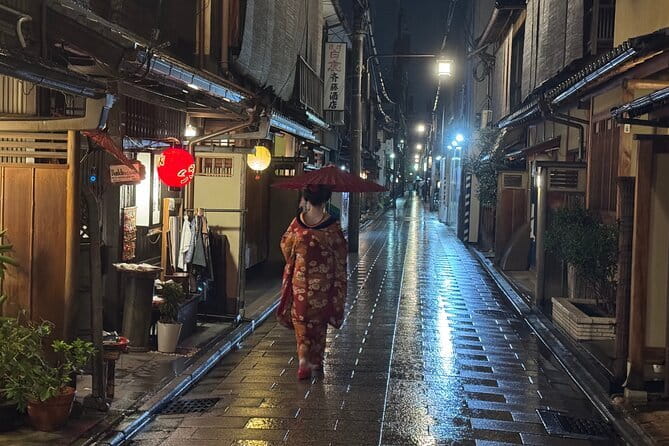
Kyoto nights move slower in your brain, not your feet. In just about 2 hours 30 minutes, you cover a clean loop of iconic Higashiyama area highlights, starting and ending at the same meeting spot near public transportation.
The best part is that the route is designed as a walking experience, not a bus-and-photos tour. That means you can slow down when you want, but your guide keeps the story moving so the evening feels full.
You can also read our reviews of more evening experiences in Kyoto

Meeting Point and How You Start the Walk
You meet at the statue of Izumo-no-Okuni on Kawabatacho in Higashiyama Ward. Since it’s near public transportation, you can usually reach the area without complicated transfers.
You’ll also get a mobile ticket, which helps if you’re juggling tickets in your phone while jet lagged. And because it’s a private tour/activity, it’s only your group, not a big shared cattle-car setup.
Stop 1: Fushimi Inari Shrine Under Glowing Torii Gates
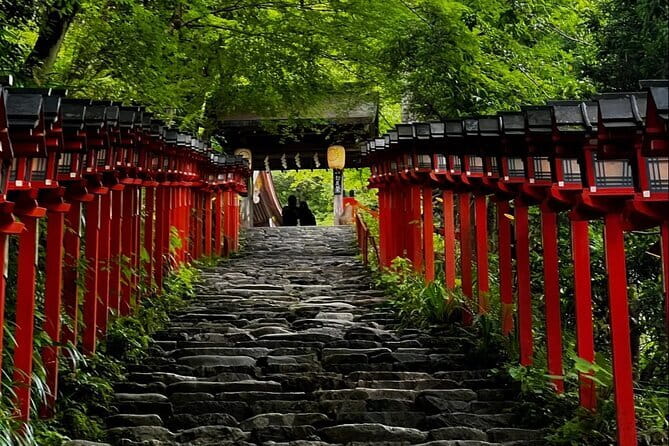
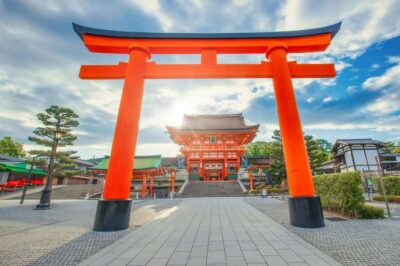
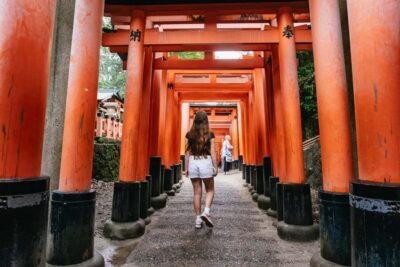
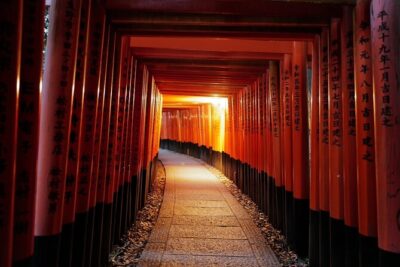
Fushimi Inari-taisha is the reason many people come to Kyoto. The famous thousands of red torii gates create a tunnel up Mount Inari, and the shrine is dedicated to Inari, the god connected with rice and prosperity.
At night, the torii feel less like a checklist and more like an atmosphere. The walkway becomes a steady rhythm: step, pause, look up, read the space, repeat. Your guide helps you understand why it’s a living shrine area rather than just an Insta background.
Practical note: this stop is around an hour, so wear shoes you trust. Even if you’re not hiking, you’re doing real walking on uneven stone paths in the dark.
Stop 2: Hanamikoji Street for That Gion-At-Night Feel
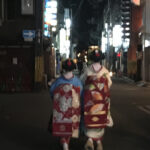
Hanamikoji Street is one of the most famous lanes in Gion. This is where traditional machiya houses and old teahouses cluster together, and where you might catch a geisha or maiko in passing.
The value of having a guide here is not hype. It’s context, like how the street functions and what details to look for as you walk. At this stop, you’re mostly soaking in the atmosphere for about 10 minutes.
If you want a quiet look at the architecture, this is a strong place to slow down for a few minutes. Just remember that night photography in narrow streets is tricky, so you’ll appreciate the photo-minded guidance.
Stop 3: Gion District, Old Streets with Less Noise

Gion is Kyoto’s most famous geisha district, known for preserved streets and traditional wooden buildings. When you visit at night, the energy shifts from crowded daytime viewing to something more like wandering.
This part of the tour gives you about 10 minutes, which is the right amount to feel the area without turning it into a long slog. Your guide ties together what you see with how Kyoto’s shrine and festival culture shaped neighborhoods like this.
This is also a good place to ask your guide quick questions. In reviews, people consistently praised guides like Ikki, Yui, and Yuri for being easy to talk to and for sharing practical recommendations beyond the tour.
Stop 4: Yasui-Konpiragu for Praying About Relationships
Yasui Konpiragu is known for prayers tied to cutting off bad relationships and shifting toward better connections. The whole idea here is simple: people come to pray for changes they want to see in real life.
This stop is short, about 10 minutes, but it’s memorable because it’s not just sightseeing. It’s a shrine with a specific emotional purpose, and your guide helps you understand how to participate respectfully.
If you’re the type who likes meaning behind the moment, this is one of the more satisfying stops on the route.
Stop 5: Yasaka Pagoda at Hokanji, a Big Wooden Landmark
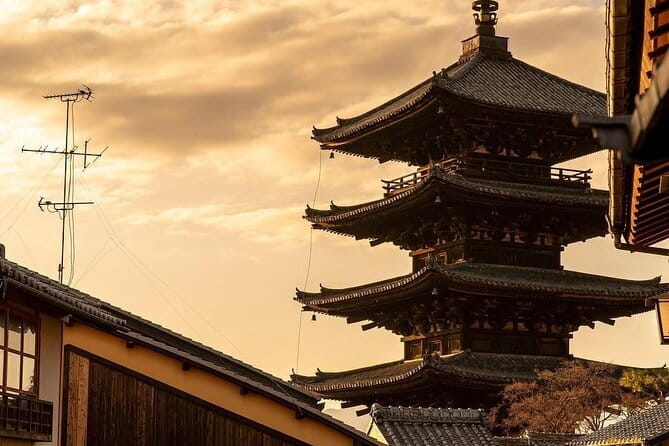
Yasakanoto is the Yasaka Pagoda (Hokanji temple), and it’s one of Kyoto’s most recognizable silhouettes. It’s often described as an old wooden structure with huge scale, and it’s known for being built without nails.
This is about 15 minutes, which is enough time to take in the size, orient yourself, and understand why it shows up in so many Kyoto photos. The nighttime lighting helps you see the pagoda as more than a static landmark.
If it’s raining or damp, don’t panic. One review noted that rain added magic rather than ruining the tour. You’ll still have the guided timing to keep moving between stops.
Stop 6: Sannenzaka and Ninenzaka, the Historic Stone Steps
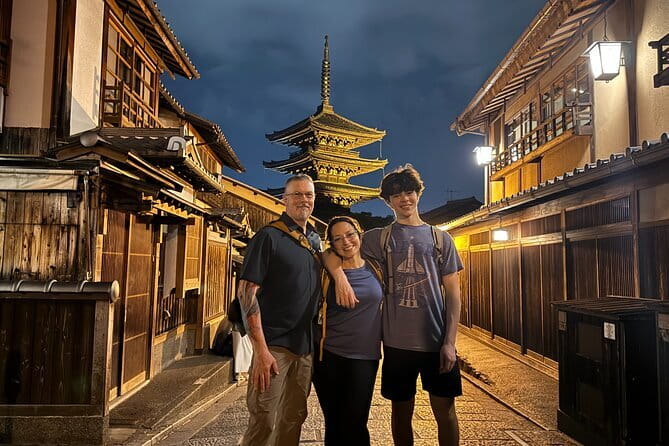
Sannenzaka and Ninenzaka are traditional stone-paved lanes lined with shops and restaurants in old-style wooden buildings. Walking here feels like slipping into another era, especially in the evening when fewer people linger.
You get about 15 minutes here, which works well because these streets pull you in different directions. Your guide can help you cross through the flow at the right moment so you spend time walking, not constantly stopping to negotiate crowds.
One tip you’ll hear from people who’ve done this: watch your step. Even in daylight, these lanes can be uneven, and at night the lighting can be less forgiving.
Stop 7: Nene-no-Michi, a Calmer Kyoto Walk
Nene-no-Michi is a named path tied to Nene, the wife of a powerful Japanese shogun. It’s known as a more serene route that passes historic temples and feels like a quieter transition between major sights.
This stop is about 15 minutes. I like this part because it breaks up the louder, more visual sections of the tour with something slower and more reflective.
If you’re traveling with kids, elders, or anyone who needs a breather between big highlights, this is the kind of stretch that helps reset your energy.
Stop 8: Yasaka Shrine, the Final Praying Moment
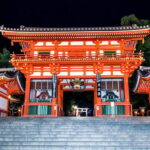
Yasaka Shrine is a major destination and the headquarters of 2,300 related shrines across Japan. It’s dedicated to gods associated with prosperity and protection, so it’s a strong closing stop for meaningful travel.
You’ll spend about 15 minutes here. Your guide will point out key moments for prayer and help you navigate the etiquette so you feel comfortable instead of guessing.
One small practical idea from the tour feedback: bring a few coins for wishing. It’s a common Kyoto habit around shrines, and it can help you participate in a simple way at the end of the evening.
What Makes the Photo Part Worth It
The tour includes professional photos taken during the walk. You don’t need to constantly request photo help from strangers, and you also don’t need to fight your camera settings in the dark while trying to listen to history.
In reviews, people described getting photos quickly after the tour. One group reported receiving 40+ photos and some short videos within about an hour. That kind of speed is a huge plus if you want to post while your memories are still fresh.
So what does that mean for you? It means you can focus on experiencing each location in the moment, then collect the best images later without stress.
Price and Value: Is $26.43 a Good Deal?
At $26.43 per person, this is a budget-friendly option for Kyoto nights. The big value is that admission fees for temples and shrines are included, and you also get an English-speaking local guide plus professional photo work.
You do still need to budget for public transportation fare, listed as ¥480 per person, and food and drinks are not included. So your total trip cost depends on what you spend before and after the tour, not just the base price.
Here’s the practical way I think about value: you’re paying to convert what could be confusing walking around into a guided, meaning-filled evening with photo support. For many first-time Kyoto visitors, that saves time and helps you understand what you’re looking at.
Pace, Physical Comfort, and What to Bring
This tour is designed as walking, with a moderate physical fitness level. The stops are mostly short, but you’re still going to cover ground at night and move between multiple areas.
My advice is to treat it like an easy evening hike, not a stroll in a park. Wear supportive shoes with decent grip. Bring a light layer for night air, and keep your phone charged, since you’ll be using it for directions and photos.
Also, build in a little extra time to arrive at the meeting point. If you’re late, you won’t be able to join and there’s no refund. That’s not a scare tactic, it’s just how group timing works when everyone has to start together.
The Biggest Strength: Guides Who Make Shrines and Streets Click
The consistent praise across the guide experiences is not just friendliness. It’s explanation that lands.
People mentioned guides like Ikki, Yui, Yuri, Yuki, Mariko, and Joi using clear communication, sometimes with laminated charts and visual explanations. That matters because shrines can be confusing at first glance, and Gion can look like a theme park if you don’t know what to notice.
Several reviews also highlighted how guides handle different group needs. One person described a smooth experience even with older visitors who needed more breaks, which tells me the guides know how to flex while keeping the schedule intact.
Who This Kyoto Night Tour Is Best For
This is a strong fit if you:
- Want to see Fushimi Inari and Gion in one organized evening
- Prefer fewer crowds at night and a calmer feel on famous streets
- Like your sightseeing with context, especially around Shinto shrines
- Appreciate photo help so you spend less time wrestling your camera in the dark
- Want a private experience without the hassle of hiring a custom guide for a full day
If you only want quick photos with zero explanation, you might find the guided stops a bit story-heavy. But if you like learning what you’re looking at while you walk, you’ll probably love the format.
Should You Book It? My Honest Take
Book this Kyoto Magical Night English Tour if you want a guided way to experience two of Kyoto’s biggest evening icons, Fushimi Inari and Gion, without feeling lost. The combination of included shrine admissions, English-speaking local guides, and professional photo support makes the price feel fair.
I’d hesitate only if you hate walking at night or you’re aiming for long, independent free time at each site. This tour is structured, and the best results come when you’re ready to keep moving with your group.
If your goal is to leave Kyoto with both memories and meaning, this is one of the more practical ways to do it in just 2.5 hours.
FAQ
How long is the Kyoto Magical Night tour?
It runs about 2 hours 30 minutes.
Where does the tour start and end?
It starts at the statue of Izumo-no-Okuni on Kawabatacho in Higashiyama Ward, Kyoto, and ends back at the same meeting point.
Is the tour mostly walking?
Yes. It’s designed as a walking experience using public transportation and plenty of time on foot.
What does the tour cost?
The price is listed as $26.43 per person.
Are temple and shrine admission fees included?
Yes. Admission fees for all temples and shrines are included.
Is public transportation included in the price?
No. Public transportation fare is listed as ¥480 per person.
Are food and drinks included?
No. Food and drinks are not included.
Does the tour include photos?
Yes. Professional photos are taken during the tour.
What happens if I’m late to the meeting point?
If you’re late, you won’t be able to join the tour and you will not receive a refund.
Is this tour private?
Yes. It’s private, and only your group will participate.
More Evening Experiences in Kyoto

More Tours in Kyoto

More Tour Reviews in Kyoto
Not for you? Here's more nearby things to do in Kyoto we have reviewed




Fushimi Inari Shrine Tours, compared.
 ★ 4.8Fushimi Inari, Kinkakuji, Bamboo Grove 1 Day Bus TourFrom $1224,316 reviews
 ★ 5.0Fushimi Inari Hidden Hiking Tour (Private Option Available)From $631,750 reviews
 ★ 4.7Kyoto/Osaka: Nara, Fushimi Inari Taisha, Arashiyama Bus TourFrom $521,275 reviews
 ★ 4.4Osaka/Kyoto: Arashiyama, Nara & Fushimi Inari Shrine w/LunchFrom $61754 reviews
 ★ 4.7Nijo Castle, Kiyomizu & Fushimi Inari Guided TourFrom $54700 reviews
 ★ 5.0Nijo, Kinkaku-ji, Arashiyama, Kiyomizu & Fushimi InariFrom $51699 reviews
 ★ 5.0Kyoto Fushimi-Inari Night Walking TourFrom $43320 reviews
 ★ 4.93-Hour Fushimi Inari Shrine Hidden Hiking TourFrom $72270 reviews
Browse the lists this tour appears in