
Reviewed · GION & GEISHA DISTRICT TOURS
Kyoto: Tea Ceremony with Maiko
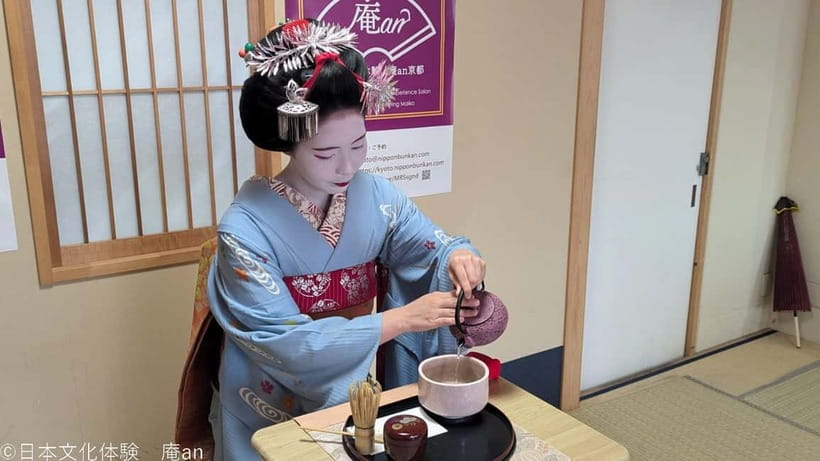
Matcha with a Maiko, no time wasted. I love the close-up feel of a Maiko-led tea ceremony and the personal touch of the Senjafuda lucky charm. You also get to make your own cup and ask real questions. The only real drawback is that it happens in a building, not a traditional ochaya-style house.
This is a smart choice when you are short on time, because it runs about 45 minutes and starts near Gojo Station. The pacing stays friendly, so you are learning and tasting, not being herded around.
My favorite part is the Q&A. You get insight into daily life and what the path toward Geiko can look like, with English help provided as much as possible.
Key moments you should care about
- Maiko matcha instruction plus hands-on making: you watch, then you whisk and serve.
- Two dried-type Japanese sweets with tea: small, Kyoto-style, and easy to enjoy.
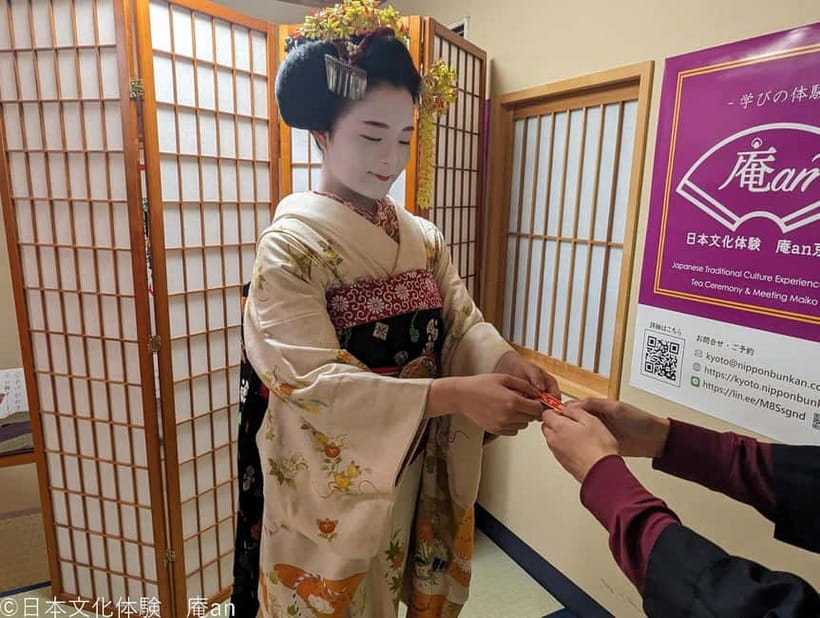
- Up-close photo time: you take a commemorative photo beside her.
- Senjafuda lucky charm gift: you leave with a small piece of the experience.
- Maiko or Geiko depending on the day: your host may change, but the format stays consistent.
Kyoto in 45 minutes: what you gain from this short format
If Kyoto is eating your schedule, this is the kind of experience that still lets you feel the city. It is compact, starting near a major subway stop, and it is built around two big Kyoto symbols at once: matcha and the world of a Maiko (or Geiko, depending on the day).
I like that it does not try to be a full-day culture program. Instead, you get focused instruction, food you can actually taste, and conversation that goes beyond canned talking points. You are in and out in under an hour, which makes it easier to pair with shopping, temple visits, or just a late afternoon stroll.
One more reason it works: the tea ceremony is not treated like a museum display. You make your own matcha, then you ask questions directly. That hands-on part is what turns it from watching a performance into doing something yourself.
You can also read our reviews of more tours and experiences in Kyoto.

Finding the Gojo Station meeting point without stress
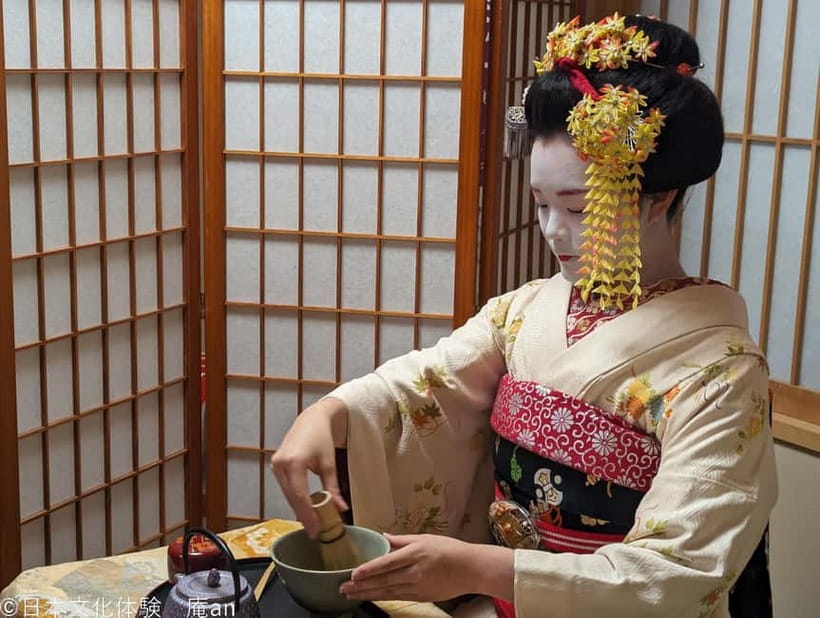
The meeting point is simple, if you arrive with a plan. You want to be at Subway Karasuma Line Gojo Station, Exit 1, then walk about 1 minute. The store entrance faces the main street, Gojo-dori.
A practical tip that saves time: look for the location above the Carnival supermarket. The directions that work best are straightforward, walk straight after exiting, cross the small street, then head straight again until you spot the building above that supermarket and go up the stairs.
One more logistics note that matters in Kyoto: there is no elevator in the building, and you will need stairs to reach each venue. If you are sensitive to stairs or carrying luggage, plan your day so you are not rushing from one end of the city to the other right before this.
What actually happens on your timeline, greeting to farewell
This experience is structured, which helps when you have a tight schedule. From start to finish, it is set up to flow like this: greeting, the tea ceremony, Q&A, then photos and the charm gift, and you are out shortly after.
When you arrive, you will start with a greeting from your host. Then comes the tea ceremony with Maiko, including making matcha with two dried-type Japanese sweets. After that, you get the Q&A session, which is one of the main reasons people book this rather than another tea stop.
Near the end, you get a commemorative photo opportunity right beside the Maiko. After the photo, you receive a lucky charm called Senjafuda. Then the host leaves the room, and you are done by around the 45-minute mark.
One helpful detail: the venue is not described as an ochaya or a traditional Japanese house. It is in a building, but the atmosphere is meant to feel relaxed, and staff are friendly. That usually means less formal pressure than some people expect.
Tea ceremony setup: respectful, but relaxed
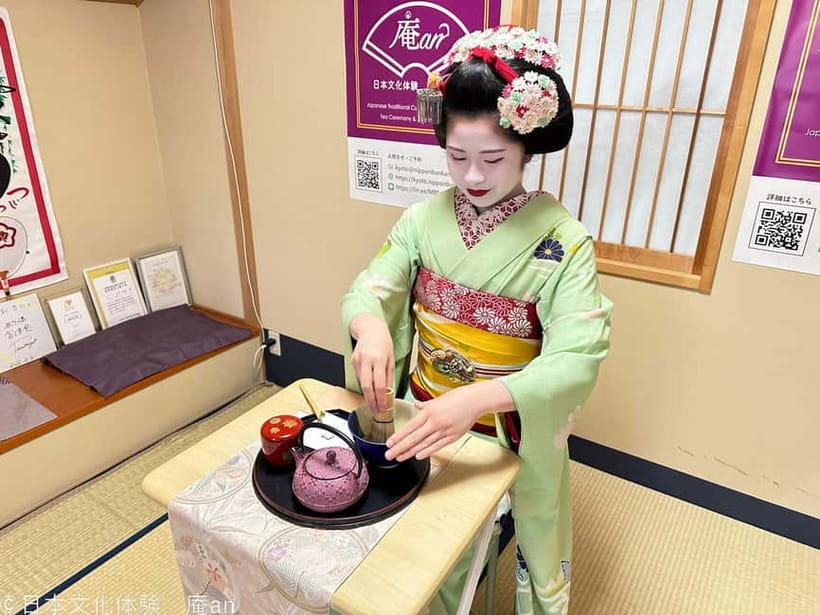
There is a difference between a tea ceremony you watch and a tea ceremony you participate in. This one leans toward participation. The host teaches and demonstrates, and you get to make the tea yourself.
You should expect a guided, step-by-step flow. The Maiko will show you how to make matcha tea, explain what you are doing, and then you will do the making. You are also served two dried-type Japanese sweets alongside the tea, which keeps the tasting simple and centered on the ceremony.
The relaxed part of the venue matters. Even though the host is a Maiko or sometimes a Geiko, the experience is not framed like a stiff, silent performance in a traditional house. You are meant to ask questions and interact, not just sit and watch.
If you want that very formal old-house vibe, you might find this less traditional in setting. But if your priority is learning the ritual basics and meeting your host up close, the format is a strong fit.
Matcha lessons you can actually use, step-by-step in your hands
This is where the experience earns its value. You do not just sample matcha, you practice it. That hands-on part helps you understand why matcha is prepared the way it is, and it gives you a better appreciation for the taste.
The host will demonstrate how to make the tea, and then you make your own cup. You get matcha served with two dried-type Japanese sweets, often called ohigashi in this kind of tea experience. Because the sweets are dried-type, they are usually easy to handle and not overly complicated to pair.
One nice detail from real sessions is that the teaching style can be very approachable. In one example, Maiko Masaya-san was noted for making the matcha learning easy, with clear answers and confident guidance. Even if your host is someone else, the goal is the same: you should understand what you are doing, not just go through motions.
Practical mindset tip: do not worry about getting it perfect. Your job is to follow along, ask if something is unclear, and enjoy the cup you make.

The Q&A session: your chance to ask about daily life and training
The Q&A is the moment that turns this from tea-making into a real conversation. This part is built in, not tacked on at the end. That means you get time to ask questions directly and learn about the host world.
The focus of the questions is naturally aligned with daily life and training, including what it can mean to work toward becoming Geiko. If that topic interests you, this is one of the clearer ways to ask without guessing or browsing for hours.
English translation is available as much as possible, and the instructor is Japanese. If you want to make sure communication is smooth, the program notes that you can contact them if you want English help added. That is worth considering if you are nervous about language.
My advice: keep your questions simple and specific. Ask about what a typical day feels like, what training is like, or what people should notice in the tea ceremony itself. When you ask with clarity, you get better answers.
Photo time beside your host, plus the Senjafuda charm
You do not have to wait for a long meet-and-greet. The photo opportunity is scheduled, and you take a commemorative photo right beside the Maiko. It is designed so you get closeness without turning it into a crowd-stalking situation.
Then comes the charming part, the Senjafuda lucky charm. You receive it from the Maiko, and it is meant to feel like a small keepsake from the moment. It is also a good reminder that this is not just a food activity. It is tied to the culture and symbolism of the host role.
If you like souvenirs with meaning, this is one of the better value add-ons. The charm is included, and it is tied to the actual ceremony, not just sold at the front desk.
Maiko vs Geiko: what changes on your date
You might be expecting a Maiko specifically, and the good news is that the experience is designed around Maiko-led tea ceremony. The fine print matters, though: depending on the event date and situation, the host may be a Geiko instead of a Maiko.
What this means for you is mainly expectations. You are still getting a tea ceremony, matcha making, sweets, Q&A time, photo time, and the Senjafuda gift. The person teaching you could be Maiko or Geiko, so if your goal is one specific category, you should be comfortable with either outcome.
The experience schedule also notes that sometimes it may be held with people having lunch or dinner, which can affect which host is available. In other words, it is not always a single fixed roster. The format stays centered on matcha and conversation.
Price and value: what $28 gets you in Kyoto
At $28 per person for about 45 minutes, you are paying for four things at once: real instruction, real participation, a hosted conversation, and an included souvenir.
Many tea experiences in Kyoto charge you mostly for tasting and watching. Here, the experience includes tea ceremony with Maiko, matcha making, two dried-type Japanese sweets, photo time, and the Senjafuda charm gift. That is a lot packed into a short window, especially since the meeting point is near a subway exit.
Is it worth it? If your goal is to meet a Maiko or Geiko up close, learn the basics of matcha preparation, and ask questions, the structure makes the price feel fair. If your goal is a long, traditional ochaya-style tea house experience with many courses, you might feel the time is short and the venue setting is simpler than expected.
Also keep in mind the overall satisfaction score is 3.5 out of 5 across 174 reviews. That suggests most people enjoy the core experience, but a few details can matter for expectations, like the venue setting and the need to be on time.
Practical tips so the 45 minutes feel effortless
A few small things can make a big difference here.
First, timing: the program runs 10:00 AM to 5:00 PM, and you should check available starting times. The program also notes that they will not be able to hold the event for delays, and latecomers will not be entitled to a refund. In Kyoto, this is important because trains, crowds, and walking take longer than maps promise.
Second, stairs: there is no elevator, so plan for steps in a building. If you have mobility challenges, you will want to know this before you go.
Third, language: the experience languages are listed as Japanese, with English translation provided as much as possible. If you have specific communication needs, contact them if you want extra English help added.
Fourth, who can join: children who require their own seat pay the same fee. Children sitting on a parent’s lap under 2 years old are free of charge. Also, people who do not participate are not allowed to enter, so plan your family schedule around that.
If you go in with the mindset of learning, asking, and enjoying what is served, the whole session tends to feel smooth.
Should you book this Kyoto tea ceremony with a Maiko?
Book it if you want a time-efficient Kyoto experience that combines matcha making, direct conversation, and an up-close photo moment with a real Maiko or Geiko. It is especially good for first-timers who want the essence of Kyoto in one focused stop, not a half-day commitment.
Skip it or reconsider if you are specifically chasing a traditional ochaya house setting, need an elevator, or want a very long tea education program. Also, be flexible about Maiko versus Geiko, since your host may change depending on availability.
If you are trying to fit Kyoto into a tight schedule, this is one of the more practical ways to get culture, food, and conversation in under an hour.
FAQ
How long is the Kyoto: Tea Ceremony with Maiko experience?
The experience lasts about 45 minutes.
Where is the meeting point?
It is a 1-minute walk from Exit 1 of Subway Karasuma Line Gojo Station. The store entrance faces Gojo-dori.
Will I make matcha myself?
Yes. The Maiko will teach you how to make matcha, and then you will make your own tea.
What is included in the price?
The experience includes the tea ceremony with Maiko, two dried-type Japanese sweets and matcha, a photo opportunity, and a Senjafuda lucky charm gift.
Will the host definitely be a Maiko?
Depending on the event date, it may be hosted by either a Maiko or a Geiko.
Is there English support?
English translation is provided as much as possible. If you would like to add it, you are asked to contact the operator.
Is the venue accessible by elevator?
No. There is no elevator in the building, and you will need to take stairs.
More Tour Reviews in Kyoto
Not for you? Here's more nearby things to do in Kyoto we have reviewed





Gion & Geisha District Tours, compared.
 ★ 4.7Kyoto Geisha Walking Tour: Gion District & Hidden GemsFrom $253,273 reviews
 ★ 4.9Gion Magical Night Walking Tour with Geisha TriviaFrom $242,393 reviews
 ★ 4.7Gion Geisha District Walking Tour – Stories of GeishaFrom $202,187 reviews
 ★ 4.9Best of Kyoto: Gion, Geisha, Pagodas & CobblestonesFrom $242,058 reviews
 ★ 4.5Night Walk in Gion: Kyoto’s Geisha DistrictFrom $212,003 reviews
 ★ 5.0Kyoto Night Foodie Tour in Gion (9+ dishes + 6 Sake tastings)From $1631,762 reviews
 ★ 5.0Kyoto Gion Geisha District Walking Tour – The Stories of GeishaFrom $251,441 reviews
 ★ 5.0Kyoto Gion: 2-Hour Geisha Culture & History Walking TourFrom $231,186 reviews
Browse the lists this tour appears in