

Reviewed · KIYOMIZU-DERA & HIGASHIYAMA TOURS
Kyoto Early Bird English Tour: Gion & Higashiyama(Private opt)
Kyoto before the crowds feels like a secret. This Kyoto Early Bird tour guides you through Gion and Higashiyama on foot, with key stops like Kiyomizu-dera and Yasaka Shrine plus a UNESCO-linked highlight along the way. You follow a smart route instead of a map, and the timing is built for seeing Kyoto while it still feels calm.
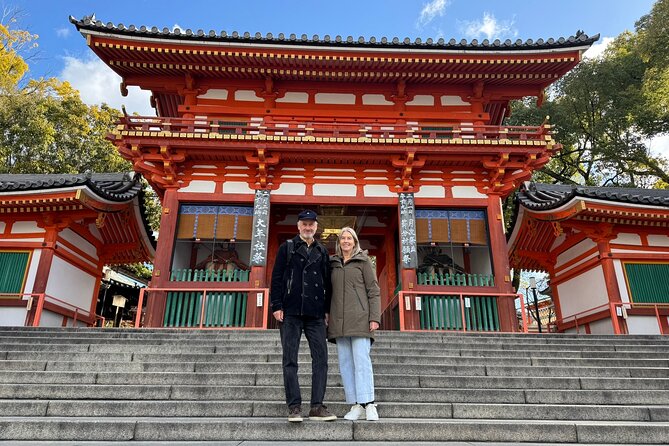
I love two things most: the professional photos you get during the tour, and the kind of patient, detail-focused guiding that helped make the early start feel easy, with guides like Ikki Kataoka setting the tone. The commentary also helps you read what you are looking at, not just take pictures.
One thing to consider is the pace. It is a walking experience with a moderate physical fitness level, and being late means you might miss the tour with no refund. Also, Kiyomizu-dera has an admission fee you pay separately.
Key things to know before you go
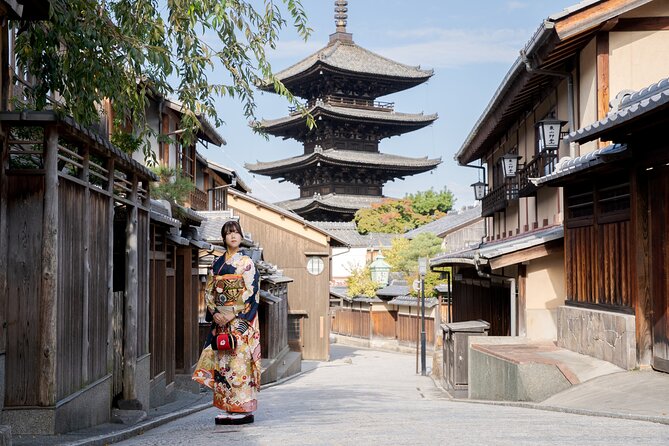
- Early timing helps you see Gion and Higashiyama before the day gets crowded
- Guide commentary makes stops like shrines and pagodas easier to understand
- Kiyomizu-dera is the only extra paid admission (¥500), everything else on the route is listed as free
- Professional photos are included, and the guide may act as a photographer too
- A compact 3-hour route keeps the day efficient, with plenty of walking
Early Bird Kyoto: why Gion feels different at the start
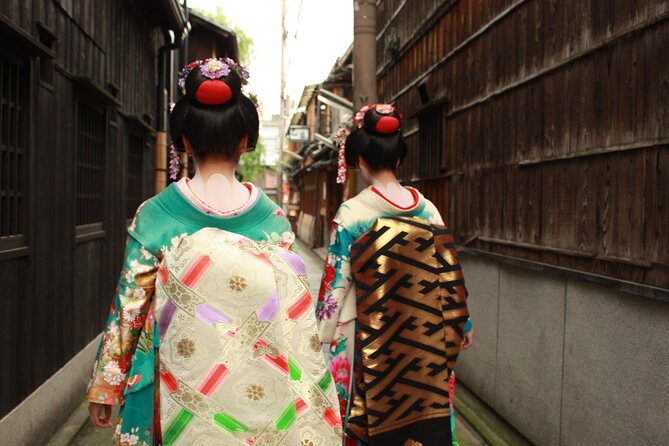
If you have ever tried to enjoy Kyoto in the middle of the day, you know how quickly it can turn into a human traffic jam. This tour’s early start matters because you get to walk through classic streets while they are still in “morning mode.” You will still see plenty of character, but without the full-on crowd pressure.
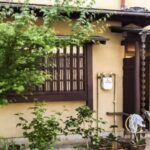
Gion is your first big taste of historic Kyoto. Expect traditional machiya houses, teahouse streets, and the preserved atmosphere of a geisha district. Even if you have seen photos before, walking through the lanes is the moment it clicks, because you can notice details like the old wooden frontage and the street rhythm.
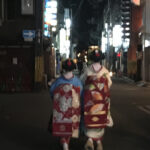
Then comes Hanamikoji Street, Gion’s famous walkway lined with traditional buildings. You might catch a glimpse of geisha or maiko, but I would treat that as a possibility, not a promise. Your real win here is the guide’s help with where to look, what is typical, and what is just scenery passing by.
You can also read our reviews of more private tours in Kyoto

Meeting point on the map: where the tour actually starts
This tour begins at the Statue of Izumo-no-Okuni, located in Higashiyama Ward. That matters because Kyoto is big on “nearby” directions that can still waste time. When your start is a specific landmark statue, you can anchor yourself fast.
The tour ends back at the meeting point. So you are not left wandering the neighborhood alone at the finish, and it makes it easier to connect to your next plan after the 3-hour walk.
The meeting area is also listed as near public transportation, which is handy if you are combining this with other sights in Kyoto.
Following Ikki Kataoka-style guidance: what the guide does for you
A guided walk can be either a lecture, or it can be practical help. The strongest feedback is about guides who spoke clear English and stayed patient, especially when guests were older. Ikki Kataoka is specifically mentioned for doing exactly that, and also for capturing great photos during the morning.
Here is what that means for you in real life. You are not just walking from point to point. You are getting context for landmarks like shrines, the kind of small details you would miss if you were speed-walking with a map app, and a pace that keeps the group together. For many people, that is the difference between seeing Kyoto and actually understanding what you saw.
Also, since this is a private option (for your group only) or a small-group option, the guide can adjust the flow. You can ask questions without feeling like you are holding up a giant crowd.
Gion streets and Hanamikoji: the photo-friendly part of the morning
The itinerary starts with Gion and Hanamikoji Street, with short stops designed to help you absorb the look of the district without rushing it. The time allocation here is tight, so you will want to arrive prepared to walk and keep your phone camera ready.
A practical tip: if geisha or maiko appear, keep your distance and stay respectful. The best photos often come from calm observation and waiting for the right moment, not from chasing.
This is also where included photography becomes useful. Even if you love taking your own pictures, having a guide who knows how to frame streets in morning light saves you time and frustration.
Yasui-Konpiragu: a shrine with a very specific prayer focus
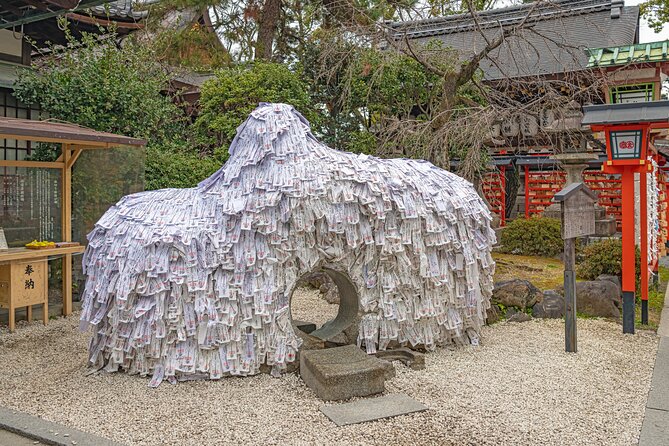
Next up is Yasui-Konpiragu (Yasui Konpira Shrine). This stop is known as a strong shrine for severing bad relationships. People come to pray for the end of negative ties and to help form new, positive connections.
Why I like including a shrine like this on a guided walk is simple: it adds meaning. Kyoto is not just buildings and views. The place names and traditions tell you what people are doing here and why. When a guide explains the theme of the shrine, you stop treating it like a background stop and start paying attention.
The stop is listed as about 15 minutes. That is usually enough time to look, understand the purpose, and move on without dragging your whole morning.
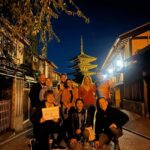
Yasaka Pagoda at Hokanji: old wood, big scale, and a famous legend
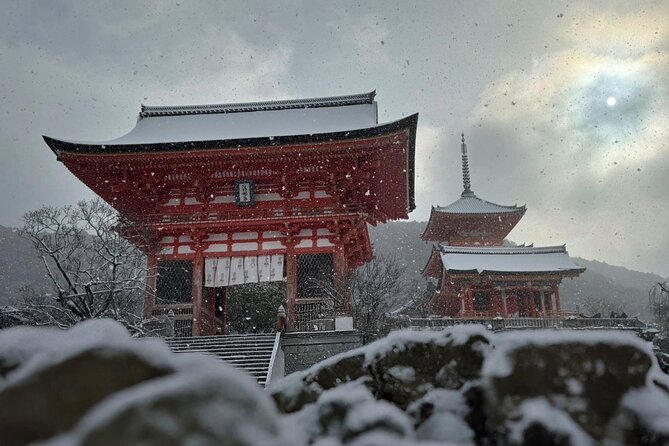
Then you get Yasaka Pagoda, connected to Hokanji Temple. It is described as one of the oldest wooden structures in Japan, and it is famous for a legend that it was built without using nails. Even if you do not care about construction trivia, the scale is the point, and the photos tend to look dramatic because you can frame the pagoda against the street context.
This stop is about 15 minutes. That is ideal if you want the story and the visuals without turning the tour into a slow museum visit.
If you are someone who likes detail, pay attention to what the guide highlights. With the right guidance, you can notice why the pagoda reads as a symbol of Kyoto instead of just another temple structure.
Sannenzaka and Ninenzaka: the walk-through time capsule
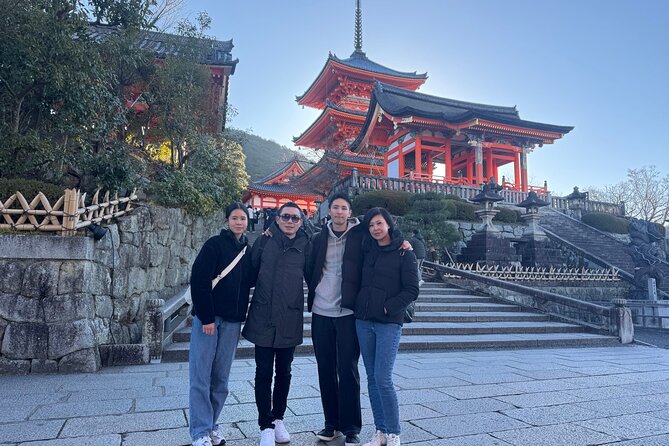
After the pagoda, the route brings you into Sannenzaka and Ninenzaka, stone-paved streets lined with souvenir shops and restaurants in historic wooden buildings. This is a classic Kyoto feel-good stop, the kind where you can drift for a minute and suddenly realize you are taking slower steps.
These streets are perfect for shopping if you want small gifts, snacks, or handmade items. But even if you do not plan to buy anything, this is one of the best stretches for simply moving at walking speed and letting the street architecture do its job.
Because you are on a schedule, keep an eye on the group and the time. The best way to shop on a structured walk is to treat it as quick browse mode, not as a deep-dive browse.
Kiyomizu-dera: the UNESCO-linked highlight and your main paid admission
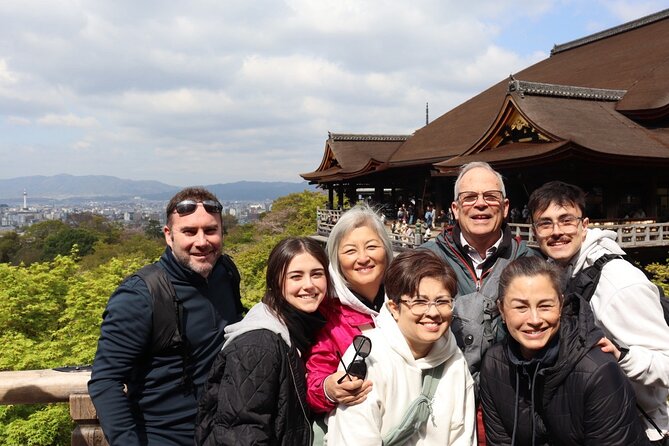
The big centerpiece is Kiyomizu-dera Temple, with about 1 hour on site. This is the most popular stop of the route, and it is the one you should mentally prepare for.
Admission is not included, so you need to budget ¥500 per person. Also, this is where you should plan for extra walking and some up-and-down movement as you work your way around the temple grounds.
Why it earns the time slot: the temple is set up on a hillside and is famous for panoramic views of Kyoto. When you add the guide commentary, it becomes more than a photo stop. You are likely to understand what you are seeing and why people treat it as a must.
If you are doing this as an early-bird tour, use that advantage well. Morning timing typically gives you breathing room compared to later in the day, and that matters when you want to enjoy views without feeling rushed.
Yasaka Koshin-Do and Yasaka Shrine: finishing with color and meaning
After Kiyomizu-dera, the tour continues with two calmer but memorable stops.
First is Yasaka Koshin-Do, described as a mysterious temple with decorations that stand out for their colorful intensity. The note here is that many temples are known for more subdued colors, so this contrast is part of what makes it visually striking. The stop is listed as about 15 minutes, which is enough time to take in the color scheme and notice how different this feels from the earlier stone streets.
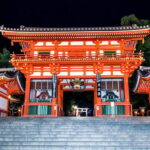
The final destination is Yasaka Shrine, with about 30 minutes. It is described as the headquarters of about 2,300 related shrines throughout Japan. The shrine is dedicated to gods of prosperity and protection, and it has played a vital role in Kyoto’s cultural life.
This ending works well. You go from famous temple views to shrine meaning, and your last walk segment is not just sightseeing. It feels like a natural wrap-up to a morning focused on spirituality, culture, and classic streets.
What you are paying for: $64.01 value and what is extra
At $64.01 per person for roughly 3 hours, you are paying for more than a route. You are buying a local English-speaking guide, an organized walking pace, and professional photos taken during the tour.
That professional-photo element is a real value point. It is not something you typically get when you DIY Kyoto on your own. In many cases, you might spend time chasing the right angles yourself. Here, the setup is built in, and in at least one early-morning experience the guide also acted as the photographer.
What is extra is pretty simple:
- Kiyomizu-dera admission is ¥500 per person
- Food and drinks are not included
So if you can handle the temple entry fee and you are okay spending about half a day walking, the price feels reasonable for the structure and the photo support.
Also worth noting: this tour offers flexible options for private or small-group format, plus group discounts and a mobile ticket.
Private versus small-group: how your day changes
This is listed as a private tour/activity, meaning only your group participates. At the same time, you can choose between private or small-group formats. That flexibility is not just a sales detail. It affects the feel.
If you book private, you tend to get a more responsive pace. If you are slower, ask more questions, or want more time at a specific stop, the guide can usually accommodate better.
If you book small-group, you get some social energy but still avoid the chaos of a huge group. And since this is an early-bird walk, small-group size helps keep conversations moving and does not turn every stop into a bottleneck.
Either way, the core value stays the same: you follow a guided route and you do not spend the whole morning negotiating where to go next.
Practical tips for a 3-hour walking morning in Higashiyama
This is designed as a walking experience, with plenty of time on foot to explore Kyoto. The fitness requirement is listed as moderate, which to me means you should be comfortable with sustained walking and the kind of uneven terrain you often find around old Kyoto sites.
A few smart choices before you go:
- Wear shoes you trust for multiple stops and potentially steep temple approaches
- Keep your phone battery charged, since you will likely use it for photos even with the included photo set
- Bring water, since food and drinks are not included
Timing is the other big factor. If you are late, you will not be able to join and you will not receive a refund. So aim to arrive early enough to take a breath and find the right meeting spot.
Finally, the tour ends back where you started. That makes your day easier to plan, because you can connect to lunch or your next Kyoto neighborhood without backtracking.
Should you book this Kyoto Early Bird English Tour?
I would book this if you want a guided, early-start walk through some of Kyoto’s classic neighborhoods, and you like learning what you are seeing as you go. The included professional photos are the kind of perk that can make a big difference, especially if you are not trying to play camera engineer all morning.
It is also a strong pick if you do not want to stress about routing. You get an itinerary flow and commentary, and that helps you spend your morning enjoying rather than figuring out.
Skip it if you hate walking, dislike temple stairs and uneven ground, or you are likely to arrive late. With the strict meeting-time rule, punctuality matters.
If you want a Kyoto morning that feels organized, photogenic, and culturally grounded, this is an easy yes.
FAQ
How long is the Kyoto Early Bird English Tour: Gion & Higashiyama?
It lasts about 3 hours.
Where is the meeting point for the tour?
The meeting point is the Statue of Izumo-no-Okuni in Higashiyama Ward, Kyoto.
Is this tour private?
Yes. It is listed as a private tour/activity, meaning only your group participates.
Can I choose a small-group option instead?
Yes. The tour offers flexible options, including private or small-group.
What is included with the tour price?
Included are a local English-speaking guide and professional photos taken during the tour.
What admission fees should I expect to pay separately?
Kiyomizu-dera Temple has an admission fee of ¥500 per person. Food and drinks are also not included.
Do I get a mobile ticket?
Yes. The tour includes a mobile ticket.
What happens if I’m late to the meeting time?
If you are late, you will not be able to join the tour or receive a refund.
Can I cancel for free?
Yes. You can cancel up to 24 hours in advance for a full refund.
More Private Tours in Kyoto

More Tours in Kyoto
More Tour Reviews in Kyoto
Not for you? Here's more nearby things to do in Kyoto we have reviewed
Kiyomizu-dera & Higashiyama Tours, compared.
 ★ 4.9Tea Ceremony in a Traditional Tea House in KiyomizuFrom $493,519 reviews
 ★ 4.7Nijo Castle, Kiyomizu & Fushimi Inari Guided TourFrom $54700 reviews
 ★ 5.0Nijo, Kinkaku-ji, Arashiyama, Kiyomizu & Fushimi InariFrom $51699 reviews
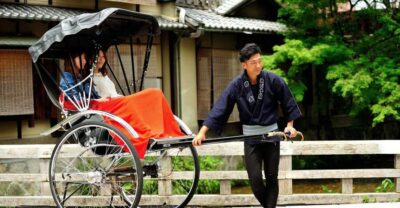 ★ 5.0Private Rickshaw Tour of Gion and Higashiyama AreaFrom $51144 reviews
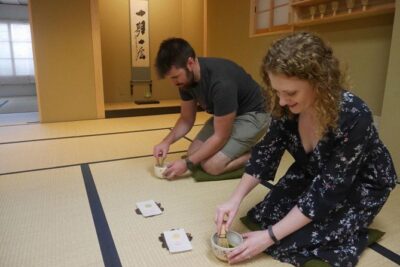 ★ 5.0Kyoto Tea Ceremony & Kiyomizu-dera Temple Walking TourFrom $109115 reviews
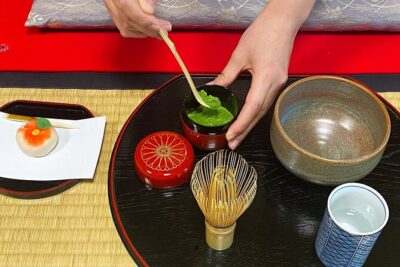 ★ 5.0Kyoto Kiyomizu Tea Ceremony with Scenic Garden ViewsFrom $50101 reviews
 ★ 4.7Kimono/Yukata Rental 5 Minute from Kiyomizu-deraFrom $1989 reviews
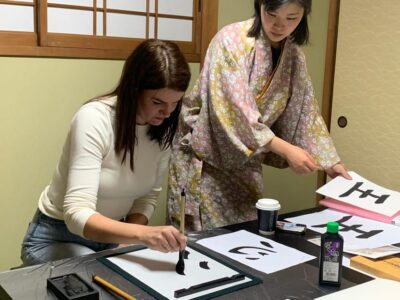 ★ 5.0Kyoto Ninenzaka : Japanese Calligraphy Class in TownhouseFrom $4959 reviews
Browse the lists this tour appears in